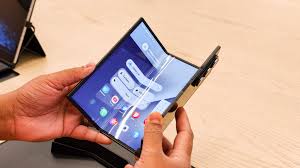
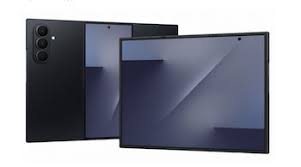
The Samsung Galaxy Z TriFold is a revolutionary triple-folding smartphone that literally unfolds the future – transforming from a pocketable phone into a 10-inch tablet. As Samsung’s latest innovation in its Galaxy Z series, the TriFold builds on years of foldable experience to deliver a device that combines smartphone portability with tablet productivity. With its unique tri-fold design, powerful hardware, and advanced software features, the Galaxy Z TriFold is poised to be a game-changer in the mobile industry.
Samsung has long led the foldable phone market with devices like the Galaxy Z Fold and Z Flip. Now, the Galaxy Z TriFold takes that evolution a step further. It features two hinges enabling an inward triple-fold, allowing the device to open out into Samsung’s largest phone display yet. This cutting-edge design is backed by top-tier specs – including a custom Snapdragon 8 Elite processor, 16GB RAM, and a massive 5,600 mAh battery – ensuring that the TriFold isn’t just novel, but also powerful. Early impressions and demand underscore its impact: the TriFold launched in late 2025 to high interest, even selling out within minutes in South Korea despite a ~$2,400 price tag. In this comprehensive article, we’ll explore the Galaxy Z TriFold’s design, features, specs, price and availability, and why it represents a bold new direction for smartphones.
Key Features at a Glance
- Triple-Folding Design: Galaxy Z TriFold folds twice with an innovative dual-hinge mechanism, converting from a standard phone form factor into a 10-inch tablet. The inward-folding design protects the main display and eliminates gaps when closed for a sleek look. It’s incredibly slim at just 3.9 mm thin when fully unfolded, and about 12.9 mm thick when folded up – remarkably compact given its triple-screen structure.
- Expansive Dual Displays: When closed, you get a 6.5-inch cover display (2520×1080, 21:9) that’s usable as a regular phone screen. Unfold it completely and you’re greeted by a 10.0-inch main display (2160×1584) that’s essentially tablet-sized. Both screens are bright Dynamic AMOLED 2X panels with smooth 120Hz refresh rates. The cover screen reaches an astounding 2,600 nits peak brightness, and the main screen up to 1,600 nits, for excellent visibility even under harsh sunlight.
- Flagship Performance: Under the hood, the TriFold packs flagship-grade specs. It’s powered by a Snapdragon 8 Elite Mobile Platform (a customized high-end 3nm chipset), paired with 16 GB of RAM. Storage options go up to 1 TB, ample for productivity and media. This horsepower ensures smooth multitasking across the large display and supports advanced AI features. Despite its slim build, the TriFold houses the largest battery ever in a Galaxy foldable – a 5,600 mAh three-part battery for all-day use – and supports 45W Super Fast Charging to recharge 50% in ~30 minutes, as well as wireless charging and reverse wireless charging for accessories.
- Pro-Grade Camera System: For photography, Samsung equips the Galaxy Z TriFold with a versatile triple camera setup. It boasts a 200 MP wide-angle main camera with OIS (delivering outstanding detail), a 12 MP ultra-wide camera for expansive shots, and a 10 MP telephoto camera with 3× optical zoom (up to 30× with digital zoom). This is on par with flagship Galaxy S-series cameras, meaning the TriFold doesn’t compromise imaging prowess. There are also dual front-facing cameras: a 10 MP selfie camera on the cover screen and another 10 MP camera on the inner screen, so you can video chat or snap selfies whether the device is folded or unfolded.
- Advanced Software & AI: Running Android 16 with Samsung’s latest One UI 8, the TriFold is optimized for productivity and multitasking. Its large display can run three apps side-by-side in split view, effectively giving you a tablet-like multi-window experience. Samsung has even introduced standalone Samsung DeX mode on this phone – a first – letting you activate a desktop-like interface on the device itself for serious multitasking (up to 4 workspaces with multiple apps each). On the AI front, the Galaxy Z TriFold is built for the modern era: it features Galaxy AI enhancements and Gemini Live, a new AI assistant that uses multimodal AI. For example, you can speak to ask questions about what’s on-screen or in view, and Gemini will analyze it and respond contextually. Photo editing gets an AI boost too, with features like Photo Assist (including Generative Edit and Sketch-to-Image tools) to help create and edit content on the fly. In short, the TriFold’s software is designed to leverage that big display with smarter, more intuitive capabilities.
- Premium Build & Durability: The Galaxy Z TriFold uses a robust build to inspire confidence in its new form factor. It introduces Samsung’s Armor FlexHinge design – actually two hinges of different sizes – that work in harmony for a stable fold with minimal gap. The hinge housing is made of titanium for strength, and the frame uses Advanced Armor Aluminum to add rigidity without excess weight. The result is a device that feels solid whether open or folded. Each unit undergoes rigorous quality tests (Samsung even uses CT scanners and laser measurements to ensure assembly precision). Additionally, the TriFold carries an IPX8 water resistance rating (equivalent to surviving 1.5m depth for 30 minutes) – a remarkable feat for a multi-hinge phone – so it can handle splashes and rain. (Note that like other foldables, it isn’t rated for dust resistance, so care is advised around sand or dirt.)
With those highlights in mind, let’s dive deeper into each aspect of the Samsung Galaxy Z TriFold and see what makes this foldable smartphone so special.
Design & Display: The Triple-Folding Form Factor of Galaxy Z TriFold
Samsung’s Galaxy Z TriFold introduces an entirely new form factor in mobile design. At first glance, when folded, it looks similar to a thick smartphone with a tall aspect ratio – thanks to its 6.5-inch cover display on the front. This cover screen is large enough for typical daily use: checking messages, making calls, apps, and even watching videos comfortably. It’s a bright, vibrant panel (2600 nits peak brightness on the cover ensures great outdoor visibility) and it supports a smooth 120Hz refresh rate, so interactions feel fluid. The cover display’s 21:9 aspect ratio means it’s narrow and easy to hold one-handed, much like a regular phone, albeit a bit thicker in profile.
However, the real magic unfolds – literally – when you open up the device. The TriFold uses two inward-folding hinges: one folding from the left and one from the right, which together allow the device to expand like a brochure. Unfolded flat, the Galaxy Z TriFold reveals a 10.0-inch main display that turns the device into a tablet. This inner display has a near-square 4:3 aspect ratio (2160×1584 resolution), offering an expansive canvas for productivity, gaming, and content consumption. To visualize it, when fully open the screen is roughly the size of three 6.5-inch smartphone screens put together in a row, creating a mini-tablet experience in your hands. Despite the multiple segments, Samsung engineered the hinges such that the screen panels meet with no noticeable gap, giving you a virtually continuous display across folds. The bezel edges are slim, maximizing the usable screen area.
Despite having two hinges and three sections, the TriFold’s build quality feels premium and sturdy. Samsung’s use of titanium and reinforced aluminum in the hinge and frame provides rigidity, so the device doesn’t flex or creak during normal use. The folding mechanism has been carefully engineered: you can feel a reassuring firmness when snapping it fully open or closed, and an auto-alert system will warn you if you accidentally try to fold it incorrectly (helping prevent damage). The craftsmanship is evident – for example, the hinge mechanism is finely tuned to distribute weight and pressure evenly, and the screens have reinforced layers to handle the stresses of repeated folding. Samsung claims each hinge can withstand hundreds of thousands of folds, and given their success with previous Fold devices, durability should be excellent for daily usage.
When folded shut, the Galaxy Z TriFold is about thick as two smartphones stacked, but it’s still impressively compact for what it achieves. The folded dimensions (~159.2 x 75.0 x 12.9 mm) make it pocketable, and at 309 grams it’s hefty but not unmanageable – comparable to carrying both a phone and small tablet, which in essence it replaces. Unfolded, the device becomes ultra-thin (only 3.9 mm thin at the thinnest part of the screen panel) – thinner than most standard smartphones. This extreme thinness when open not only looks futuristic but also makes holding it as a tablet quite comfortable. Samsung achieved this slim profile by splitting components like the battery into three smaller units across the panels and using an advanced hinge design that minimizes gaps.
The visual experience on the TriFold is stunning. The inner 10-inch display is an AMOLED panel with rich colors (DCI-P3 100% color volume) and great contrast, so whether you’re editing photos, watching a movie, or reviewing documents, everything looks crisp and vibrant. The main screen’s peak brightness of 1600 nits ensures that even in tablet mode, you can use it outdoors without strain. Meanwhile, the cover screen’s exceptional brightness (one of the brightest on any phone) means you won’t miss a thing when using it closed on sunny days. Both screens support HDR and the fast 120Hz refresh, making scrolling and animations buttery smooth.
One thing to note about the design: currently, Samsung offers the Galaxy Z TriFold in a single color option called “Crafted Black.” This matte black finish gives it a sleek, professional look. The uniform color across the hinge and frame adds to the device’s premium aesthetic. There’s no official stylus support mentioned, which suggests the TriFold might not work with an S Pen (unlike some earlier foldables). It’s possible Samsung opted not to add a digitizer layer to keep the screen thin – something to consider for users who hoped to draw or take notes on the big screen. Nonetheless, the large display is perfect for using a finger or third-party stylus for basic touch interactions.
In summary, the Galaxy Z TriFold’s design merges phone and tablet in a cohesive way. When you want compact convenience, it folds down to a smartphone that can slip in your pocket. When you need a larger canvas, it unfolds into a tablet with more screen real estate than any previous Galaxy phone. Samsung’s achievement here – delivering a gapless, durable triple-fold – truly feels like a peek into the future of smartphone design.
Performance & Hardware: A Pocketable Powerhouse
A fancy design alone means little without the performance to back it up. Thankfully, the Samsung Galaxy Z TriFold comes with top-of-the-line hardware that puts it on par with, or even above, other flagship phones of its generation. This device is engineered for heavy multitasking and productivity, so Samsung has equipped it accordingly.
At its core, the TriFold runs on the Qualcomm Snapdragon 8 Elite Mobile Platform for Galaxy, a special high-performance chipset built on a 3nm process. This chip is akin to the latest Snapdragon 8 series (found in other 2025–2026 flagships) but customized for Samsung. It delivers blazingly fast CPU and graphics performance, which is crucial given the TriFold’s ability to run multiple apps simultaneously on a large screen. Whether you’re editing a document while on a video call and streaming music in the background, or playing an intensive 3D game, the Galaxy Z TriFold handles it with ease. In day-to-day use, the UI feels snappy and responsive, even when transitioning between folded and unfolded states.
Backing the processor is a whopping 16 GB of RAM, which is more than many laptops and ensures smooth operation even with many apps open. This abundance of RAM is especially useful for the advanced multitasking features on the TriFold – for instance, running three apps split-screen or keeping a Samsung DeX workspace active. You’re unlikely to run out of memory, which means less lag or app reloads when switching contexts.
Storage options include 512 GB or 1 TB of internal storage , both sizeable enough for power users. With up to 1 TB, users can store tons of photos, 4K videos, large applications, and files, essentially using the TriFold as a mobile workstation. (Do note, there is no microSD card slot – much like other recent premium Galaxy phones – so what you buy is what you have in terms of storage. Opt for the 1TB model if you foresee needing huge storage, especially for professional use.)
Graphics and media performance on the device are excellent. The Snapdragon 8 Elite’s GPU can drive the high-resolution 10-inch display for gaming or video playback without breaking a sweat. High-fidelity games run smoothly, and the experience of gaming on such a big screen is immersive – almost like a console handheld. The phone-tablet hybrid form really shines here: you could connect a Bluetooth controller and essentially have a portable console with a 10-inch display, or use touch controls with plenty of screen space for your fingers.
Audio is another important part of the hardware. Samsung typically equips its flagships with stereo speakers, tuned by AKG, and the TriFold likely follows suit (with one speaker on each end of the device when unfolded). Users report that the sound is loud and rich for a phone – great for watching movies or video conferencing. And of course, Bluetooth 5.4 support means you can use the latest wireless earbuds or headphones for audio as well.
When it comes to connectivity, the Galaxy Z TriFold is thoroughly modern. It supports 5G networks (both Sub6 and mmWave in relevant markets) for the fastest mobile data speeds. It also includes the new Wi-Fi 7 standard, which means it’s future-proofed for the next generation of Wi-Fi routers and can achieve extremely fast wireless LAN speeds (useful for DeX or high-speed data transfer). Standard features like NFC for Samsung Pay, GPS, and the latest Bluetooth are all present. For security, there’s a side-mounted fingerprint scanner (embedded in the power button, since an in-display sensor isn’t feasible on a folding screen) and of course face recognition using the cameras.
One aspect where the TriFold truly stands out is battery and power management, which we’ll cover in more detail later. But in brief, Samsung managed to pack a 5,600 mAh battery by splitting it into three cells tucked into each section of the device. This capacity is larger than the battery in the Galaxy Z Fold7 and even bigger than the batteries in most standard phones, which is impressive given the TriFold’s thickness constraints. It needed that juice to power the big screen, and initial reports suggest it can get through a full day of moderate use. Fast charging at 45W means you can refill the battery to 50% in around half an hour with the proper adapter, which is convenient for a quick top-up before unfolding into a marathon work session.
Samsung is also ensuring that the TriFold isn’t just a short-term novelty – they are committed to software support. The phone ships with Android 16 and One UI 8, and Samsung has promised extended updates for this premium device. In fact, early information suggests the Galaxy Z TriFold will receive up to 7 years of OS updates and security patches. That means users could get Android version upgrades into the 2030s, which is unprecedented longevity for an Android phone. This extended support makes sense given the TriFold’s high price tag; buyers can be assured their investment will remain up-to-date and secure for a very long time.
In summary, the Galaxy Z TriFold’s hardware is no less cutting-edge than its design. It’s a performance beast with one of the fastest chipsets available, ample memory, and all the modern connectivity one could ask for. Whether you’re a multitasking professional, a power user, or just someone who demands top performance, this device is built to handle it.
Software & Productivity: Multitasking on a Massive Screen
The Samsung Galaxy Z TriFold doesn’t just give you a large screen – it provides the software experience to make that screen truly productive. Samsung’s software team has adapted One UI and Android to fully leverage the TriFold’s unique capabilities, making it a multitasker’s dream device.
When you open the TriFold into tablet mode, the interface seamlessly expands. You can run multiple apps at once in split-screen or pop-up views, just as you might on a tablet or PC. In fact, the TriFold can comfortably show three apps simultaneously in a side-by-side layout. For example, you could have a web browser, a document editor, and a messaging app all open at once, sharing the 10-inch display. Each app would appear roughly phone-sized (since the screen is like three phones wide), which is incredibly useful for cross-referencing information or doing complex tasks. Imagine reviewing a spreadsheet, writing an email, and participating in a video call all at once – the TriFold makes that possible in a handheld device.
To manage this, Samsung’s Multi-Window feature has been optimized. You can drag and drop apps into different parts of the screen, resize windows, or use the taskbar (which sits at the bottom of the large display) to quickly launch and switch apps. The taskbar is similar to a desktop computer’s, showing your recent and favorite apps for quick access. This means less time fiddling and more time being productive.
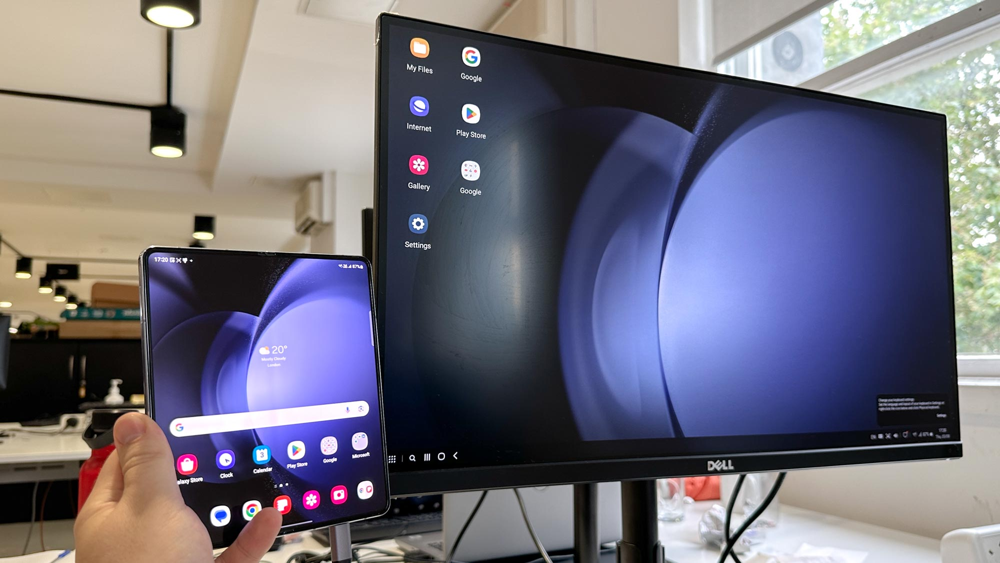
One of the headline software features is the introduction of Standalone Samsung DeX on the TriFold. DeX is Samsung’s desktop-style interface that previously required an external monitor or TV. On the TriFold, however, you can activate DeX mode directly on the device’s own screen. This essentially turns the 10-inch display into a mini desktop computer interface – complete with resizable windows, a start menu-like app launcher, and the ability to run up to 4 separate workspaces (each can have multiple apps). In DeX, you could, for instance, have Word, Excel, and a browser all in free-form windows, just like on a PC. Pair a Bluetooth keyboard and mouse, and the TriFold becomes a literal laptop replacement you can use anywhere. You could start drafting a presentation in DeX mode on the train, then later plug the TriFold into a monitor or use wireless display casting and continue with a full monitor and peripherals – it’s incredibly flexible.
Samsung has also ensured that core apps and popular third-party apps are optimized for the folding display. Continuity is a key feature: if you’re using an app on the cover screen and then unfold the phone, the app smoothly transitions to the big screen, expanding to show more content. Conversely, you can start something on the big screen and fold the device – the session can continue on the cover screen (for supported apps) without interruption. This is great for, say, Google Maps or YouTube; you can unfold to get a better view, then fold when you need to move, all without restarting the app.
The AI features on the Galaxy Z TriFold also deserve mention. Samsung is branding the phone as ready for the “AI era,” and it has baked in some smart functionality. One example is Gemini Live, Samsung’s new intelligent assistant that leverages the phone’s cameras and mics in novel ways. With Gemini, you can point the TriFold’s camera at something (or share your screen) and ask questions like “What am I looking at?” or “Summarize this document for me,” and it will attempt to provide answers by analyzing the visual input, thanks to on-device AI. In a demo, Samsung showed a user pointing the phone at a living room and asking for decor advice – Gemini could see the room, note the furniture, and suggest design tips. This kind of multimodal AI (understanding images, voice, and context together) is cutting-edge and the TriFold’s powerful hardware makes it feasible. It’s like having a smart assistant that can actually see and interpret what you see.
Another cool AI-driven feature is in the camera and gallery: Photo Assist with Generative Edit. This lets you do things like remove objects from photos or even generate new imagery within a photo using AI, directly on the device. For instance, you could take a photo of a landscape and then ask the phone to “add a sunset” – the generative AI would edit the photo to include a realistic sunset, marking the image appropriately as AI-generated. The large screen makes these editing tasks easier, as you have a bigger view and more precise controls.
Productivity apps like Samsung’s own Samsung Notes, Microsoft Office, Google Workspace apps, and others are all optimized for the large display. You can use a full-width on-screen keyboard in tablet mode for typing (or pair a physical keyboard). There’s even the ability to have a floating video player (picture-in-picture) while working on other apps – essentially, you can multitask to an extent that was previously impossible on a phone.
For creative users, the lack of built-in stylus support is a small drawback, but one could still use a capacitive stylus for basic sketching or note-taking. Perhaps a future version will add official stylus capability. For now, the focus is clearly on multi-app productivity and AI enhancements.
Overall, the software experience on the Galaxy Z TriFold is about unlocking new ways to work and play on a mobile device. It blurs the line between phone and PC. Early users have nicknamed it a “pocket PC” because, in many scenarios, you truly don’t need to open a laptop – the TriFold can handle it. Samsung’s refinements in One UI make the experience smooth: from dragging and dropping content between apps, to using keyboard shortcuts in DeX mode, it’s clear that the TriFold is aimed at professionals, power users, and anyone who wants to do more on the go. It’s productivity unleashed, and it sets a high bar for what foldable software can achieve.
Camera Capabilities: A Studio in Your Pocket
Despite the Galaxy Z TriFold’s unusual form, Samsung ensured it received a flagship-tier camera system. In fact, the TriFold inherits camera specs comparable to the top Galaxy S series phones, meaning you don’t sacrifice photography quality for the sake of folding design.
The headliner is the 200 MP main wide-angle camera. This extraordinary high-resolution sensor allows for detailed shots and the flexibility to crop in without losing much clarity. Samsung likely uses pixel-binning (combining pixels) to output 12 MP or 16 MP images by default with improved low-light performance, but you can take full 200 MP shots for maximum detail if needed. In practice, photos from the main camera are sharp, vibrant, and hold up even when zooming in or printing large. The inclusion of Optical Image Stabilization (OIS) and advanced image processing means the TriFold can handle nighttime and low-light scenes with ease, using techniques like multi-frame capture to reduce noise.
Accompanying the main lens is a 12 MP ultra-wide camera that captures a 120° field of view. This is perfect for landscapes, large group photos, or creative wide-angle shots. Ultra-wide images come out with Samsung’s typical color science – punchy and wide in perspective, and the distortion at the edges is well-controlled for a natural look. The ultra-wide doubles as a macro camera too, letting you get up close to subjects for detailed close-ups.
For zooming, the TriFold has a 10 MP telephoto camera offering 3× optical zoom and up to 30× digital Space Zoom. At 3× optical, you get lossless zoom which is great for portraits or distant subjects. Even beyond that, up to 10× zoom images are surprisingly decent thanks to AI Super Resolution processing, though at the maximum 30× the quality drops (as expected, since it’s largely digital zoom at that point). Still, having some zoom capability means the TriFold is versatile – whether you need to capture something far away during a trip or just want a nice compressed background effect for a portrait.
Samsung also equipped the TriFold with not one but two front-facing selfie cameras. When the device is closed, you have a 10 MP selfie camera integrated into the cover display (in a small punch-hole). This works like any smartphone selfie cam – convenient for quick snaps or video calls without opening the phone. When you unfold the TriFold, there’s another 10 MP camera on the main inner display. This inner camera means you can do video calls on the big screen, which is fantastic for productivity (imagine having a Zoom meeting on a 10-inch screen you can prop up, without needing a laptop). The inner camera might be an under-display camera or in a slim bezel; Samsung’s documentation suggests it’s likely a tiny hole-punch or under-display tech similar to the Fold series. In either case, it’s mainly for video calls or quick selfies – it won’t be as high-quality as the main cameras, but it’s adequate for face-to-face chats and face unlock.
One fun aspect of having a phone that folds is using the rear cameras for selfies. Just like the Galaxy Z Fold, the TriFold allows you to use the rear triple cameras as high-quality selfie cameras by taking photos with the device partially folded. For example, you can prop the TriFold in an “L” shape (half folded) on a table; then the cover screen can act as a viewfinder while the 200 MP main camera (or ultra-wide, or telephoto) captures you. This way, you can get ultra-sharp selfies or group shots with the timer, far superior to what the front cameras can do. The cover screen preview ensures you can frame yourself even when using the rear cameras.
In terms of video, expect the Galaxy Z TriFold to record up to 8K video (likely at 30fps) on the main camera, and 4K on others, consistent with Samsung’s flagship capabilities. The large form factor might also aid in stabilization – with the device unfolded, holding it with two hands like a mini tablet can provide very stable footage, aided by OIS and electronic stabilization. The phone’s powerful processor can handle advanced video features like HDR10+ recording, super slow-motion, and more.
Samsung’s camera software brings a host of modes: Night Mode, Pro Mode (for manual controls), improved Portrait Mode (with adjustable background blur), and fun modes like Directors View, where you can record using front and back cameras simultaneously – taking advantage of multiple cameras on this device. All these modes benefit from the TriFold’s hardware. For instance, in Director’s View, you could use the inner screen to see all your camera angles at once (front, rear wide, rear telephoto) and tap to switch, treating the device like a mini director’s monitor.
Another advantage is playback and editing: after you take photos or videos, reviewing them on a 10-inch screen is a joy. You can see far more detail on the TriFold’s display than you could on a normal phone, which helps in selecting the best shots or doing on-the-go edits. The AI-powered editing tools we mentioned (like Generative Edit) can be used to tweak photos creatively. And for professionals, the large screen plus optional S Pen (if it were supported in future) or just finger controls could make the TriFold a viable field photography tool for quick edits and uploads.
Overall, the Galaxy Z TriFold’s camera setup ensures that despite its unconventional shape, it competes with the best camera phones out there. Whether you’re capturing vast landscapes, snapping ultra-detailed photos, or taking video calls on the move, the TriFold has you covered with a lens for every occasion. It truly is a studio in your pocket – foldable, but no less capable.
Battery Life & Durability: Powering the Future
One of the engineering triumphs of the Samsung Galaxy Z TriFold is how it manages power and durability, given its complex design. Having a large screen and two hinges could easily have been a recipe for short battery life and fragility, but Samsung tackled these challenges head-on.
Battery Life: As mentioned, the TriFold carries a triple-part battery totaling 5,600 mAh capacity. This is larger than the battery in most smartphones and even beats the Galaxy Z Fold7’s ~4,400 mAh pack by a significant margin. The approach was to distribute three smaller batteries into each section of the device, balancing weight and maintaining the slim profile. The result is impressive endurance: in phone mode (using the cover screen only), the TriFold easily lasts a full day or more since the external display is no more power-hungry than a normal phone panel. In tablet mode (main screen), battery life will naturally be shorter if you’re continuously using that big 10-inch display – but thanks to adaptive refresh rate and optimizations, it’s still very usable. The display can dial down to low Hz when static to save power, for instance.
For mixed usage (some folded, some unfolded), early testers found the TriFold can get through a workday of heavy multitasking. All-day battery life is achievable, especially with typical breaks in usage. And if you do run low, the 45W fast charging means you can get a significant recharge in a short time. Using Samsung’s 45W adapter, you can go from 0 to about 50% charge in roughly 30 minutes, which is remarkable for such a big battery. In practical terms, a quick charge while you have lunch or during a meeting could give you enough juice for the rest of the day. The TriFold also supports Fast Wireless Charging 2.0 (15W) and reverse wireless charging (Wireless PowerShare) to top up earbuds or a smartwatch on the go.
The battery is designed as a three-cell system not only for fit, but also for thermal management. Spreading the cells out helps dissipate heat across the device, which can prolong battery health and also keep the device cooler under load. Samsung has decades of experience with batteries and they’ve applied stringent safety checks here, so despite the unconventional shape, charging and discharging should be as safe as any other Galaxy device.
Durability: Durability is a common concern with foldable phones – more moving parts can mean more points of failure. Samsung addressed this with a combination of material innovation and testing. The Armor Flex Hinges are perhaps the most robust hinges Samsung has made yet. Each hinge has a dual rail structure and they differ in size, but work together to evenly support the screen. This design minimizes stress on any single point. Additionally, when the TriFold is closed, the hinge mechanism ensures the screen sections don’t press against each other; there’s a slight clearance aided by the frame design so that the inner displays avoid scratching or damage.
The use of titanium for the hinge housing is a step up from the aluminum used in earlier Folds – titanium is stronger and more resistant to wear. The frame’s Advanced Armor Aluminum gives rigidity so you won’t feel flex when the device is open flat. On the back, Samsung opted for a ceramic-fiber reinforced polymer material, which keeps the back lightweight yet crack-resistant. This polymer back also probably helps with wireless signal penetration (as opposed to having all metal back).
Samsung put each unit through rigorous testing. Internally, they mentioned using CT scans to inspect the folding circuit boards and laser measurements to ensure components are perfectly mounted. They also likely performed hundreds of thousands of fold cycles in testing. The hinge is rated for a high number of folds (previous folds were rated around 200,000; we can expect TriFold to be similar or better). What about real-world durability? Early durability tests (by third parties) have been encouraging – the hinge mechanism is solid and the device showed good resilience in initial scratch and bend tests. That said, as with any foldable, caution is advised: you wouldn’t want to get small debris in the hinge. The IPX8 water rating gives peace of mind against accidental dunks or rain, but the TriFold is not dust-proof. Users should avoid environments with lots of sand or dust, or use a protective case that can keep particles out of the hinge.
Thermal durability is another aspect – packing such powerful hardware in a slim device means potential heat. However, the TriFold’s expansive surface area when unfolded actually helps disperse heat. Plus, Samsung likely used a multilayer cooling system (graphite or vapor chamber) to manage temperatures. In practice, the device might get warm under heavy multitasking or gaming, but the large form helps prevent it from feeling too hot to handle.
One more point on durability: Samsung offers an incentive for TriFold buyers with its care services. Typically, foldables come with premium after-sales support, like discounted screen replacements or extended warranties. We expect Samsung to provide options like Samsung Care+ for TriFold owners, which covers accidental damage. Given the new form factor, it’s wise to consider such protection, especially for early adopters.
In essence, the Galaxy Z TriFold’s battery and durability aren’t weak spots – they’re strengths. The device packs enough power to last all day, and it’s built toughly enough to withstand everyday use. Samsung’s years of refinement in foldables show here: the TriFold feels like a polished culmination, not a first-gen experiment. Users can be confident carrying this expensive device that it’s not overly fragile. Treat it well (as you would any high-end phone), and it will reward you with a reliable, enduring experience that truly powers you through your day.
Release Date, Price, and Availability of Galaxy Z TriFold
Samsung officially unveiled the Galaxy Z TriFold on December 2, 2025 during a special announcement, generating instant buzz among tech enthusiasts. The device’s release strategy has been a bit unique, targeting select markets first before a wider rollout.
The Galaxy Z TriFold first launched in South Korea (Samsung’s home market) on December 12, 2025. Unsurprisingly, it created a frenzy. Despite its ultra-premium price, the initial batch in Korea sold out within minutes of release. Customers lined up at stores and scrambled online to secure the TriFold, highlighting the strong demand for this cutting-edge device. Samsung even had to organize a quick restock, which again sold out rapidly, indicating they might have underestimated how many people would be willing to adopt this new form factor early.
In terms of pricing, Samsung has positioned the Galaxy Z TriFold at the very high end of the market. In South Korea, it is priced at ₩3,599,000 KRW, which converts to roughly $2,430 USD for the base model. That’s actually slightly lower than some pundits expected (many predicted over $3,000), but it’s still more than double the price of a typical flagship phone. In other initial markets, the price varies: for instance, China and Taiwan see it around the equivalent of $2,600, in Singapore it’s closer to $2,700, and in the United Arab Emirates it’s about $3,200 (the highest, likely due to import costs). These variances make South Korea ironically the most affordable place to buy the TriFold at launch, before taxes or promotions.
For the U.S. and Europe, Samsung confirmed that the Galaxy Z TriFold will be available in early 2026. Specifically, they mentioned a U.S. release in the first quarter of 2026. Many expect it to coincide with or follow the Galaxy S26 launch timeframe, possibly around March 2026. As of now, Samsung hasn’t announced the exact U.S. price, but based on other markets, analysts predict a price around $2,499 USD for the 512GB model, with a higher cost for the 1TB model. Samsung will likely try to keep the U.S. price competitive (on the lower end of the global range) to encourage adoption and because of currency differences. In Europe, prices could easily exceed €2500 given VAT.
Early buyers in Samsung’s initial markets have often been offered perks – for example, the Korean launch bundled a free Galaxy Watch for early pre-orders. We anticipate similar promotions in new markets (perhaps including freebies like the Galaxy Buds or discounts on Samsung’s tablets/monitors to use with DeX). Moreover, Samsung provides a 6-month trial of Google’s AI Pro services for TriFold buyers, emphasizing the AI capabilities (this trial includes some Google cloud AI features and storage, which complements the device nicely).
Availability will initially be limited. Samsung is rolling the TriFold out in a controlled manner, likely to manage production yield and gauge demand. By early 2026, apart from Korea, the TriFold is expected to be available in China, Taiwan, Singapore, UAE, and then the United States, with possibly a few European and other Asian markets following. If you’re outside these regions, obtaining a TriFold might require importing one for the time being. As always, with such an expensive device, ensure that the model you buy supports your local 5G bands and that warranty service can be handled.
For those who absolutely want to be among the first, keep an eye on Samsung’s official website and major carriers/electronics retailers in Q1 2026 for pre-order announcements. Given the sell-outs in Asia, it wouldn’t be surprising if the TriFold sees limited stock and high demand in Western markets as well – early adopters and tech aficionados are eagerly waiting. Samsung’s own site in Korea even had a notification sign-up because units were selling out so fast.
In summary, the Samsung Galaxy Z TriFold is a niche, ultra-premium device, and its price reflects that. However, the strong sales in initial markets show there is a appetite for innovation even at a steep cost. As production ramps up and more markets get the TriFold, it will be interesting to see how widely it catches on. For now, it’s a status symbol and a technological marvel rolled into one – available to those willing to pay the price and possibly wait through some stock shortages. If you’re eyeing one, prepare your wallet, and be ready to move fast when it becomes available in your region!
Conclusion: Unfolding a New Future in Mobile Tech
The Samsung Galaxy Z TriFold represents a bold leap forward in smartphone innovation. By combining the convenience of a phone with the productivity of a tablet, Samsung has essentially given us two (or even three) devices in one. The TriFold’s ingenious triple-hinged design, powerful internals, and refined software experience all come together to paint a picture of what the future of mobile computing could look like. It’s not just an incremental upgrade; it’s a reimagination of the smartphone form factor.
Using the Galaxy Z TriFold feels like having a glimpse of tomorrow’s tech today. Folded, it’s a familiar yet chunky smartphone – handy and compact. Unfolded, it’s an immersive canvas that can replace your tablet or even laptop for many tasks. This flexibility means the TriFold can adapt to your needs on the fly: you read a quick message on the cover screen, then open up to edit a document on a large display; you snap a photo with the phone closed, then unfold to meticulously edit it in Lightroom; you take a call on one side while referencing notes on the other side of the open screen. It truly unfolds new possibilities for multitasking and creativity.
Of course, being an early adopter of such cutting-edge tech comes with considerations. The high price and first-generation nature of the tri-fold form factor mean this device is geared towards enthusiasts, professionals, and luxury tech consumers. It’s not a mainstream phone – at least not yet. But neither were the first Galaxy Fold devices a few years ago, and now foldable phones are growing in popularity and coming down in price. The Galaxy Z TriFold similarly paves the way; we can expect that in a few years, tri-folding devices (perhaps with even more polish and maybe lower cost) could become part of Samsung’s regular lineup and inspire competitors.
Speaking of competition, Samsung’s move with the TriFold also solidifies its position at the forefront of foldables. Other manufacturers have showcased tri-fold concepts or dual-hinge prototypes, but Samsung is the first to bring a polished tri-fold phone to market at scale. This gives them a serious edge in experience and user feedback for this form factor. It will be interesting to see how rivals respond – we might see companies like Huawei, Xiaomi, or others attempt their own triple-folding devices. In the end, that’s great for consumers and the industry, as it pushes innovation further.
For those wondering if the Galaxy Z TriFold is worth it, the answer really depends on what you value. If you’re someone who yearns for the absolute latest tech and can take advantage of the big screen for work or entertainment, the TriFold could dramatically enhance your mobile life. The experience of carrying a pocketable device that can unfold into a tablet on demand is undeniably cool and useful. On the other hand, if you’re more price-conscious or just need a basic phone for communication, this isn’t the device for you – and that’s okay. Samsung continues to offer a spectrum of devices from traditional phones to flips and folds to suit different needs.
In closing, the Samsung Galaxy Z TriFold is a trailblazer. It merges premium smartphone capabilities with an innovative folding design to deliver something new and exciting. Yes, it’s costly and a bit experimental, but it also redefines what a smartphone can be. Today it’s a marvel for early adopters; tomorrow it could influence the design of many devices. As it stands, the TriFold firmly cements Samsung’s message: the era of flat, static smartphones is evolving, and the future is one we’ll unfold – literally – one fold at a time.
External Links
Introducing Galaxy Z TriFold: The Shape of What’s Next in Mobile Innovation
https://news.samsung.com/us/samsung-introducing-galaxy-z-trifold-shape-whats-next-mobile-innovation
Galaxy Z TriFold Sells Out in Minutes Despite $2,400 Price Tag
Introducing Galaxy Z TriFold: The Shape of What’s Next in Mobile Innovation
https://news.samsung.com/us/samsung-introducing-galaxy-z-trifold-shape-whats-next-mobile-innovation
Galaxy Z TriFold– Samsung Mobile Press
https://www.samsungmobilepress.com/media-assets/galaxy-z-trifold?tab=specs
Galaxy Z TriFold– Samsung Mobile Press
https://www.samsungmobilepress.com/media-assets/galaxy-z-trifold?tab=specs
Introducing Galaxy Z TriFold: The Shape of What’s Next in Mobile …
Introducing Galaxy Z TriFold: The Shape of What’s Next in Mobile Innovation
https://news.samsung.com/us/samsung-introducing-galaxy-z-trifold-shape-whats-next-mobile-innovation
Galaxy Z TriFold– Samsung Mobile Press
https://www.samsungmobilepress.com/media-assets/galaxy-z-trifold?tab=specs
Galaxy Z TriFold– Samsung Mobile Press
https://www.samsungmobilepress.com/media-assets/galaxy-z-trifold?tab=specs
Introducing Galaxy Z TriFold: The Shape of What’s Next in Mobile Innovation
https://news.samsung.com/us/samsung-introducing-galaxy-z-trifold-shape-whats-next-mobile-innovation
Introducing Galaxy Z TriFold: The Shape of What’s Next in Mobile Innovation
https://news.samsung.com/us/samsung-introducing-galaxy-z-trifold-shape-whats-next-mobile-innovation
Introducing Galaxy Z TriFold: The Shape of What’s Next in Mobile Innovation
https://news.samsung.com/us/samsung-introducing-galaxy-z-trifold-shape-whats-next-mobile-innovation
Introducing Galaxy Z TriFold: The Shape of What’s Next in Mobile Innovation
https://news.samsung.com/us/samsung-introducing-galaxy-z-trifold-shape-whats-next-mobile-innovation
Galaxy Z TriFold– Samsung Mobile Press
https://www.samsungmobilepress.com/media-assets/galaxy-z-trifold?tab=specs
Introducing Galaxy Z TriFold: The Shape of What’s Next in Mobile Innovation
https://news.samsung.com/us/samsung-introducing-galaxy-z-trifold-shape-whats-next-mobile-innovation
Introducing Galaxy Z TriFold: The Shape of What’s Next in Mobile Innovation
https://news.samsung.com/us/samsung-introducing-galaxy-z-trifold-shape-whats-next-mobile-innovation
Introducing the Galaxy Z TriFold: The Shape of What’s Next in …
Introducing Galaxy Z TriFold: The Shape of What’s Next in Mobile Innovation
https://news.samsung.com/us/samsung-introducing-galaxy-z-trifold-shape-whats-next-mobile-innovation
Galaxy Z TriFold– Samsung Mobile Press
https://www.samsungmobilepress.com/media-assets/galaxy-z-trifold?tab=specs
Galaxy Z TriFold– Samsung Mobile Press
https://www.samsungmobilepress.com/media-assets/galaxy-z-trifold?tab=specs
Galaxy Z TriFold– Samsung Mobile Press
https://www.samsungmobilepress.com/media-assets/galaxy-z-trifold?tab=specs
Introducing Galaxy Z TriFold: The Shape of What’s Next in Mobile Innovation
https://news.samsung.com/us/samsung-introducing-galaxy-z-trifold-shape-whats-next-mobile-innovation
Galaxy Z TriFold Sells Out in Minutes Despite $2,400 Price Tag
Introducing Galaxy Z TriFold: The Shape of What’s Next in Mobile Innovation
https://news.samsung.com/us/samsung-introducing-galaxy-z-trifold-shape-whats-next-mobile-innovation
Introducing Galaxy Z TriFold: The Shape of What’s Next in Mobile Innovation
https://news.samsung.com/us/samsung-introducing-galaxy-z-trifold-shape-whats-next-mobile-innovation
Introducing Galaxy Z TriFold: The Shape of What’s Next in Mobile Innovation
https://news.samsung.com/us/samsung-introducing-galaxy-z-trifold-shape-whats-next-mobile-innovation
Galaxy Z TriFold– Samsung Mobile Press
https://www.samsungmobilepress.com/media-assets/galaxy-z-trifold?tab=specs
Galaxy Z TriFold– Samsung Mobile Press